See what empty slots cost — then build a process to refill them.
Enter your last 30 days below. You will see the revenue that never came in and the opportunity a repeatable refill process could protect.
VAGA Protocol gives you the tracking sheets, messages and refill workflow for US$10, backed by a 30-day guarantee.
Get VAGA Protocol for US$10 →This isn't a no-show. It's a refill that didn't happen.
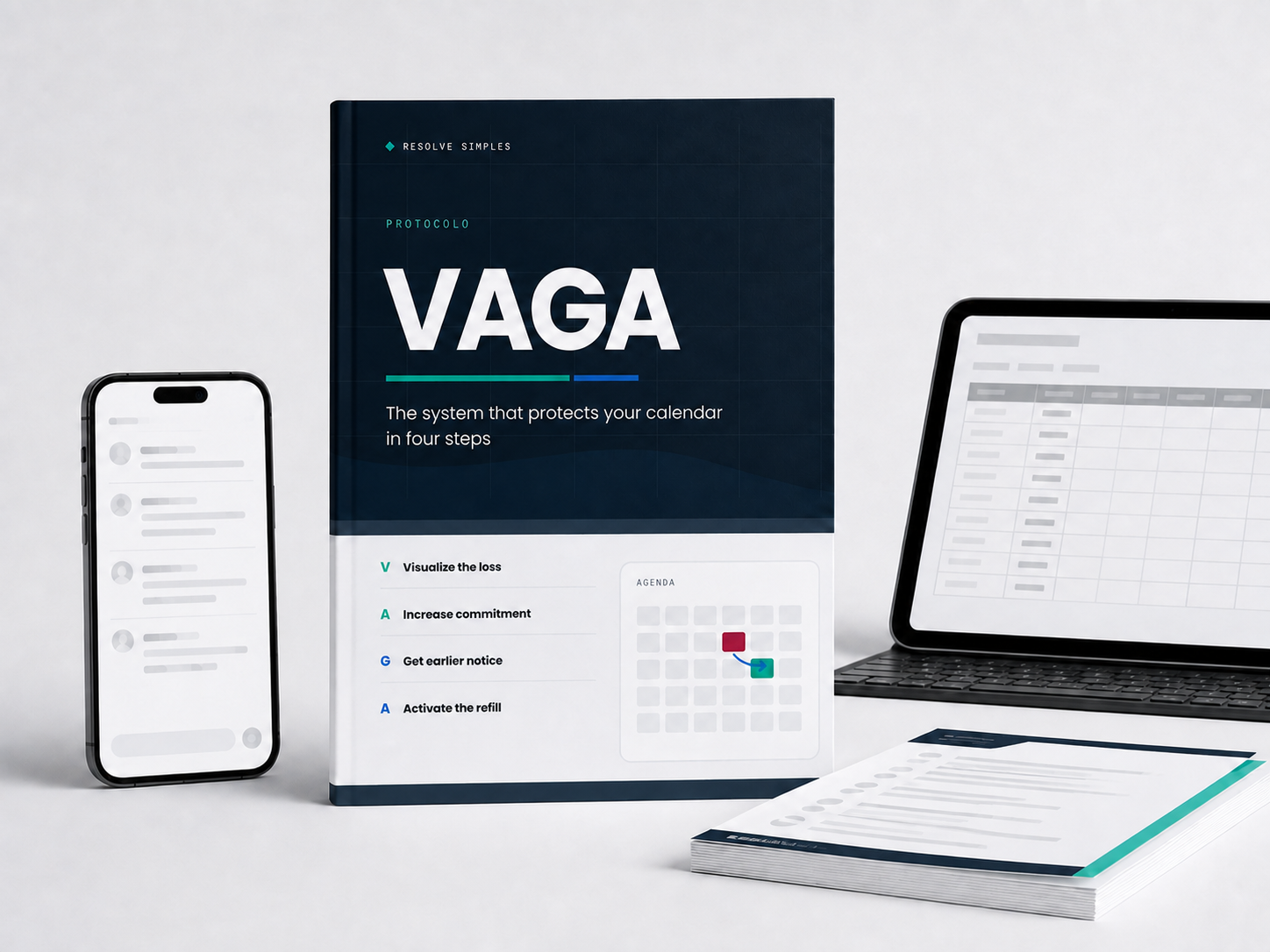
Two businesses with the exact same cancellation rate can close the month with opposite results — the entire difference is what each one does in the 15 minutes after the cancellation lands. VAGA Protocol is the system that teaches exactly that, in four steps: measure the loss, reduce no-shows, get earlier warning, and fill the slot before it becomes a loss. Built for owners and for whoever runs the calendar every day.
Who VAGA Protocol is for
Whoever hits "buy," the result shows up for three different people.
You own the business and your team will run it
You don't want to keep reminding, nagging and repeating the same instruction every week. The front-desk manual and the 15-Minute Action Card do that work for you — your team runs it on its own, even on days you're not watching.
You own the business and run the calendar yourself
You don't have a free weekend to build a spreadsheet, test messages and research what works. For US$10, the research, templates and workflow are already organized — useful even for solo operators, where every recovered slot matters.
You manage the calendar, but you're not the owner
Running the protocol and showing the result in numbers — in the tracking sheet, in black and white — is a concrete case to bring to your manager. Better fill rate, better cash flow: that's how you make the case for a raise.
One recovered US$10 slot offsets the purchase price
VAGA Protocol
Stop improvising after every cancellation. Use one simple workflow to measure the leak, reduce avoidable no-shows and refill openings faster.
One-time payment
US$10
Instant digital access after payment. No subscription and no paid booking software required.
Get VAGA Protocol for US$10Secure checkout by Kiwify · Card or Apple Pay · 30-day money-back guarantee
- Measure: Tracking Sheet shows no-shows, recovered slots and revenue at risk by staff member, day and service.
- Prevent: 40 message templates, editable cancellation policies and a messaging-app setup guide help clients confirm or warn you sooner.
- Refill: Waitlist Sheet, 15-Minute Action Card, front-desk manual and 7-day rollout plan tell your team what to do when a slot opens.
Two tracking sheets, 40 messages, five editable documents, a team manual and a rollout plan — ready to use, not another course to finish.
30-day guarantee. Apply it, measure it in the Tracking Sheet, and if you don't see a difference in your numbers, you get every cent back — no questions asked. All the risk is on us.
No rush: the free calculator above stays yours whether you buy or not.
Why an empty slot costs more than it looks
Anyone who sells booked time has a problem retail doesn't: inventory that spoils on the spot. A store that didn't sell a product today sells it tomorrow. A salon whose chair sat empty from 2pm to 3pm never sells that hour again — it simply stopped existing.
That's why the cost of a no-show isn't just the price of the service. During that gap, rent kept running, staff stayed on the clock, and the lights stayed on. Fixed costs ran with nothing coming in on the other side.
And a last-minute cancellation is the worst version of the problem. Someone who cancels three days out hands back a slot you can still sell. Someone who cancels at 9am for a 10am appointment hands back a slot nobody can fill in time.
The three fronts of anyone who actually fixes this
Almost every business only attacks the first front — sends a reminder and stops there. That's why the problem persists even in businesses that confirm religiously.
1. Prevent the cancellation
The research is consistent on one point: the longer the gap between booking and the appointment, the higher the odds someone won't show. Booking far in advance is convenient for you and risky for your calendar. That should change what you do at the moment of booking — not just the day before.
- Shorten the gap between booking and the appointment whenever possible
- State the cancellation policy clearly at the moment of booking, not after
- Ask for an active confirmation, with a reply, instead of just sending a reminder
- Reward prepayment instead of penalizing no-shows
2. Get the warning earlier
Not every cancellation can be prevented — people get sick, cars break down, kids get sick. In those cases the goal changes: it's not about stopping the cancellation, it's about getting it earlier. A cancellation that lands 48 hours out is a slot you can still sell; the same cancellation landing 40 minutes out is money already lost.
That means making it easy to cancel before the critical window — which is counterintuitive. People afraid of being charged or shamed just disappear, and disappearing is the worst possible outcome for you.
3. Fill the slot that opened up
This is the front almost nobody runs, and it's where the money is. It doesn't help much to learn about a 9am cancellation if nobody does anything until 10am. Fast refilling depends on having a waitlist ready before the slot opens, sorted by service and by who can come in same-day.
Without that list, you post to your story and hope. With it, you send three targeted messages and fill the slot.
See what this is worth in your own numbers
Can I do this without paid software?
Yes. The essentials run on the messaging app you already have and a spreadsheet: quick replies set up, labels to mark who's confirmed, an organized waitlist, and a simple log of what happened for each slot.
Booking software speeds things up and cuts manual work, but it isn't what solves the problem. What solves it is having a defined process for all three fronts — and most businesses that buy software still don't have a process, and still have the same hole.
Frequently asked questions
How do I calculate how much I'm losing to no-shows?
Add up last-minute cancellations and no-shows over the past 30 days, subtract the slots you managed to refill with someone else, and multiply the result by your average ticket per appointment. That's the revenue that never came in that month; multiply by 12 for the yearly projection. The calculator at the top of this page does exactly that math.
Can I charge a cancellation fee to a client who no-showed?
In most places, a cancellation fee is only enforceable if it was clearly disclosed and agreed to before booking. A surprise charge applied only after the fact tends to be disputed and can hurt your reputation. In practice, many businesses get better results offering a small discount for prepayment than penalizing people who no-show. This is general information, not legal advice for your specific location.
What's the best appointment confirmation message?
One that asks for an active reply instead of just reminding. A message that only states the date gets little response; a message that asks for a short confirmation creates a small commitment and reveals earlier who isn't going to show up — which gives you time to offer the slot to someone else.
How do I fill a slot that opened up at the last minute?
With a waitlist organized before the slot opens, sorted by service and by availability on short notice. When a cancellation lands, you offer the slot to someone who already showed interest in that specific service, instead of posting to everyone and waiting for a reply.
What's a normal no-show rate for salons and clinics?
There's no single reliable published average across salons, barbershops and aesthetic clinics — be skeptical of anyone quoting an exact industry number. The strongest data comes from healthcare: a review of 105 studies published in Health Policy found an average no-show rate of 23%, with huge variation between countries and specialties. Treat it as an order of magnitude, not a benchmark for your business. That's why the calculator uses your own numbers instead of an average.
Do I need paid software to reduce no-shows?
No. The essentials — active confirmation, a clear policy, an organized waitlist and a simple log — run on a messaging app and a spreadsheet. Paid software speeds things up, but it isn't what makes the initial difference.
You've already seen the size of the hole. The only question is when you fix it.
Every month without a system is another month paying rent, staff and utilities for slots nobody refilled. For many businesses, VAGA Protocol costs less than a single appointment, and you get 30 days to try it risk-free.
Get VAGA Protocol now · US$10